"And when they were come into the house, they saw the young child with Mary his mother, and fell down, and worshipped him: and when they had opened their treasures, they presented unto him gifts; gold, and frankincense, and myrrh" (Matthew 2:11)
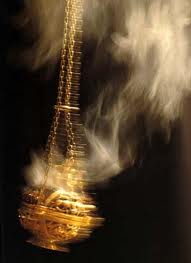
Frankincence is an aromatic resin used in incense and perfumes. It comes from Boswellia trees. Four types species of Boswellia are used and each of them give a resin with variation depending on tree-type, soil, climate and time of harvesting. Boswellia thrive in arid, cool areas of the Arabian Peninsula, East Africa and India. The finest type is Boswellia sacra, which grows in Somalia, Oman and Yemen. To obtain the resin you cut the bark of the tree which then starts to bleed a fluid that hardens. The hardened resin is called tears.

Frankincense trees are true survivors. They can grow in very demanding conditions, sometimes directly on solid rock in stormy areas. The rougher the conditions, the stronger the aroma. The trees have to be 8-10 years old to produce resin. It seems that there is a declining amount of frankincense trees, partly because of over-exploitation but also as a consequence of beetle attacks. The predictions are quite sad unfortunately so it might be a good idea to stock up on essential oils.
Frankincense is the incense of incenses, and appears in both Bible and Talmud. According to the gospel of Matthew 2:11, gold, frankincense, and myrrh were among the gifts to Jesus from the wise men. It has been used for a very long time, for example it is known that frankincense has been traded on the Arabian Peninsula and in North Africa for more than 5000 years. At that time it was known as olibanum. This name is likely to be derived from the Arabic al-lubān which is a reference to the resin being “milked” from the tree.
Frankincense is the incense of incenses, and appears in both Bible and Talmud. According to the gospel of Matthew 2:11, gold, frankincense, and myrrh were among the gifts to Jesus from the wise men. It has been used for a very long time, for example it is known that frankincense has been traded on the Arabian Peninsula and in North Africa for more than 5000 years. At that time it was known as olibanum. This name is likely to be derived from the Arabic al-lubān which is a reference to the resin being “milked” from the tree.
 |
| Henry Siddons Mowbray |
If you should have the fortune to visit Oman, you can go to the excavation of Ubar, a trade center along the "Incense Road", that was rediscovered in the early 1990s.
Frankincense has a sweet, warm, balsamic aroma that is stimulating to the mind. The scent uplifts, calms and comforts and is therefore a natural choice for religious and spiritual ceremonies and for meditation. The tree itself is a symbol of life and carries cultural and historical significance. In Ayurvedic medicine Indian frankincense (Boswellia serrata), also known as "dhoop," has been used for hundreds of years for treating arthritis, healing wounds, strengthening the female hormone system, and purifying the atmosphere from undesirable germs. In Indian culture, it is suggested that burning frankincense daily in the house brings good health.
I think frankincense is a good example of our olfactory memories and identities, not as individuals, but as humans. We have used the same olfactory symbols for thousands of years, and we use them to worship in different religions. Scent is cultural, but also trans-cultural. Scents repel, and connect. Scents, like you, like me, are not arbitrary. Being aware of this makes the search for fragrances even more special and full of mysteries, symbols and stories, does it not?
If you are interested in going on a frankincense perfume exploration, here are some suggestions.


Frankincense has a sweet, warm, balsamic aroma that is stimulating to the mind. The scent uplifts, calms and comforts and is therefore a natural choice for religious and spiritual ceremonies and for meditation. The tree itself is a symbol of life and carries cultural and historical significance. In Ayurvedic medicine Indian frankincense (Boswellia serrata), also known as "dhoop," has been used for hundreds of years for treating arthritis, healing wounds, strengthening the female hormone system, and purifying the atmosphere from undesirable germs. In Indian culture, it is suggested that burning frankincense daily in the house brings good health.
I think frankincense is a good example of our olfactory memories and identities, not as individuals, but as humans. We have used the same olfactory symbols for thousands of years, and we use them to worship in different religions. Scent is cultural, but also trans-cultural. Scents repel, and connect. Scents, like you, like me, are not arbitrary. Being aware of this makes the search for fragrances even more special and full of mysteries, symbols and stories, does it not?
If you are interested in going on a frankincense perfume exploration, here are some suggestions.